- Homer's Odyssey: https://amzn.to/3JBMhJD
- William Shakespeare: https://amzn.to/38BKozG
- Canterbury Tales: https://amzn.to/3KEqZwg or https://amzn.to/3KGWh5M
- What is a limerick? https://literarydevices.net/limerick/
- Langston Hughes: https://poets.org/poet/langston-hughes
- One Little Word: https://aliedwards.com/one-little-word-2021
- Eckhardt Tolle: A New Earth: https://amzn.to/37cBLew
- Blackout Poetry: https://writers.com/what-is-blackout-poetry-examples-and-inspiration
Looking at ourselves and the world through the lens of the 21st century.
Wednesday, April 13, 2022
Heard It on the Podcast - April 13, 2022
Cindy Murray is a widow, mother, and grandmother who enjoys nature, good food, and friends. She's an artist, writer, and musician who came from a small town, moved to the big city, and loves to travel. She is the co-founder of Crafty Neighbor, a crafter's resource and events organizer, and the author of Crafty Neighbor's Neighborhood Gossip, a blog about crafting and the crafts industry. Cindy has worked as a travel agent since 2010 and is the owner/founder of Crafty Neighbor Travel. You can find links to all of Cindy's websites, blogs, and social media accounts here: https://linktr.ee/CraftyNeighbor
Tuesday, April 12, 2022
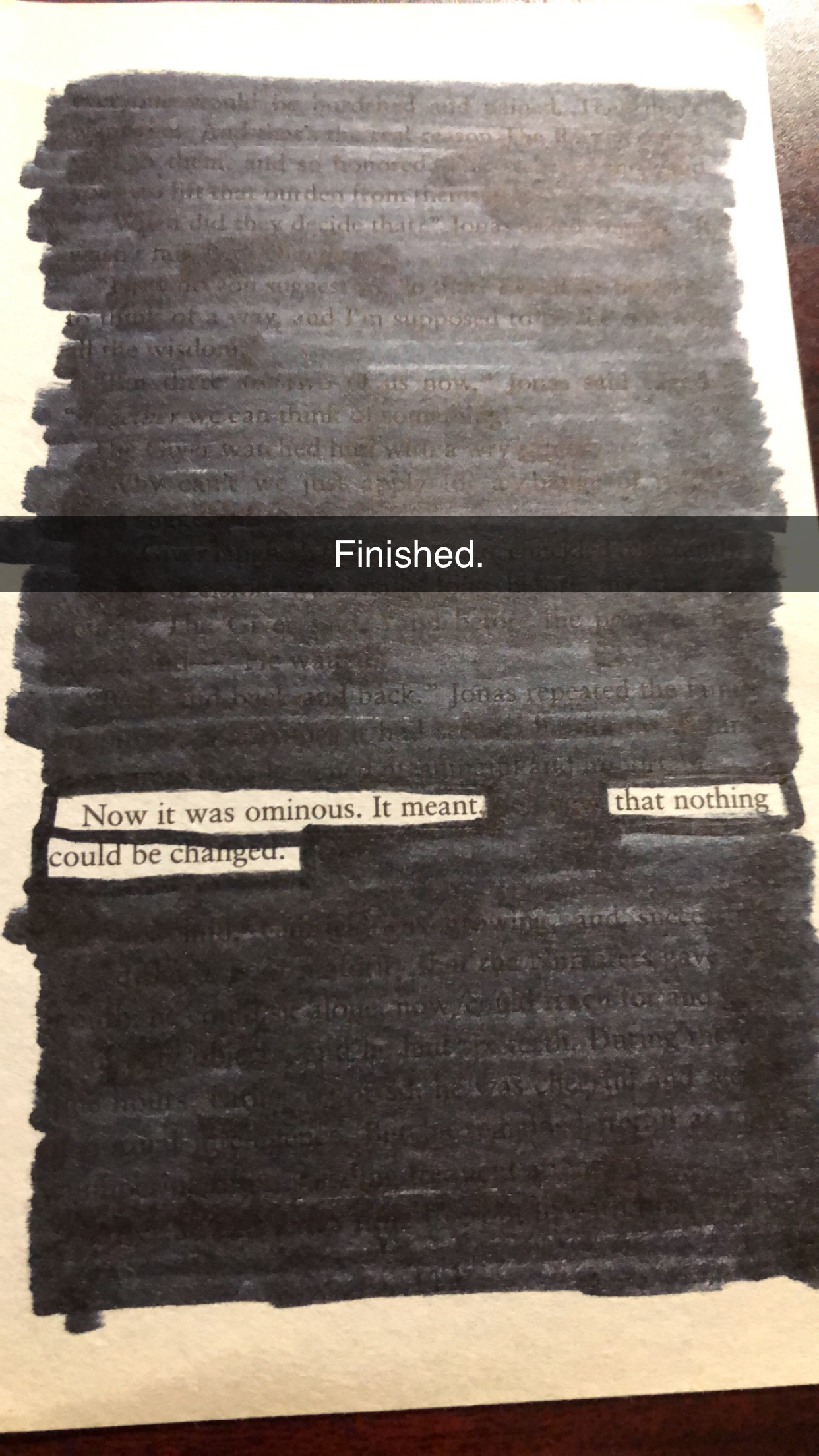
Blackout Poetry For Everyone
How to create a blackout poem:
- Step 1: You need a printed form of media, a pencil, and a marker or paint.
- Step 2: Find your anchor words. When you read through the page, use your pencil to underline the words or phrases that appeal to you.
- Step 3: Find your filler words and underline them. These are the words that you use to string together your anchor words to create your poem.
- Step 4: Box in your words. I like to draw a box around my words in pencil first and then go over the box with a sharpie pen, making sure there is enough room around the words for mistakes.
- Step 5: Black it out. With your marker (preferably a darker color) or paint, begin to blackout all of the other words around your boxes.
- There are no rules when it comes to blackout poetry! You don’t have to rhyme and it doesn’t even have to make sense!
- It is okay to mess up!
- HAVE FUN and enjoy yourself!
Voila! You have created your poem! Are you ready to take it to the next level?
- Blackout your words with different colors.
- Make designs around your boxed-in words that are relevant to your poem.
- Turn your poem into mixed media art on a canvas.
As an Amazon Associate, I earn from qualifying purchases.
Monday, April 11, 2022
Celebrating National Poetry Month
When it comes to poetry, my students often get discouraged because they feel like they don’t understand what poems are trying to say due to the nuance of poetry devices. The first thing I tell them is that anyone can write a poem. I do this in two different ways: imagery and blackout poetry, and I frame my unit with these two things.
- Imagery Poem: Imagery is “visually descriptive figurative language using the five senses.” Before we even talk about poetry, I have my students write about their favorite food using each of the five senses: see, touch, hear, smell, and taste. This is usually a five-minute beginning of class activity and I remind them not to overthink it, to write the first thing that pops up in their head. You can find my lesson here.
- Lyric Poetry: I once took a class on the best ways to teach poetry from Laura Randazzo and I still use many of her techniques in my classroom to date. She suggested comparing and contrasting modern songs to older-style songs. My favorite comparison is "Stereo Hearts" by Gym Class Heroes (2011) and "My Love is Like a Red, Red Rose" by Robert Burns (1794) because they are using similes and metaphors to compare love in their lyrics. This leads me to my first project.
- Figurative Language in Song Lyrics: After comparing songs and studying different styles of lyrical poetry such as sonnets, psalms, dramatic, and ballads, students must showcase a type of poetic device using song lyrics. They get to present/or read their findings to the class and explain in a presentation how what they choose is figurative language and what it means. This is a fun project for my students because they get to listen to music and examine their favorite songs more closely.
- Rhyme Games or Poetry Slam: I do this when I teach my 9th Grade “Sonnets”. As we mentioned in the podcast, sonnets are a bit hard to follow if you don’t understand Shakespeare or rhyming. This game can also easily turn into a poetry slam because Shakespeare’s sonnets are a lot like rap music. I use "Sonnet 18" by William Shakespeare, and I read it really quickly to my students like I am rapping it, and then I show them a parody of the same poem by an unknown writer on my Sonnet Worksheet and challenge my students to write their own parodies. If they have trouble rhyming, I direct them to RhymeZone.
Alternate Forms of Poetry: I like to teach my students blackout poetry, which I will go into detail about in a future blog. I also like to teach students about found poetry, which is similar to blackout poetry, and book spine poetry (pictured), which is made by stacking books on top of each other in different ways. These are some of the simplest ways to make poetry.
- Poem in Your Pocket Day: On the upcoming podcast, I also mention “Poem in Your Pocket Day” which will take place this month on April 29th. The idea is to take a small poem that fits in your pocket and make that your poem for the day. The Academy of American Poets has a few suggestions on how everyone can celebrate National Poetry Month such as drawing an image of your chosen poem, recording yourself reading it and uploading it on social media, or making an origami sculpture out of the poem. I uploaded a PDF of their suggestions here.
I encourage my readers to not be intimidated by poetry because everyone is a poet, even if they don’t know it. Explore poetry with some of my suggestions above, and when you are ready, give some of my favorite classics a try (listed below). Let’s continue the conversation on our Facebook Page and our Facebook Group MMC Chat.
Some of My Favorite Classic Poems:
Sunday, April 10, 2022
Everyday Tasks
- Sunday: Laundry and Vacuum Day. I do this simultaneously between laundry loads.
- Monday: Kitchen Day. I typically run the dishwasher, clean my counters, and stove, and clean out my fridge on this day.
- Tuesday: Bathroom Day. I typically clean most of my bathroom this day. I clean my shower daily as I shower. This is a hack I picked up from TikTok (featured on ThisYouNeed).
- Wednesday: Miscellaneous Dusting/Clutter Day. I typically try to lightly dust my bookshelves, window sills, and blinds for cobwebs if needed. I also try and go through any clutter that is amassed during the week and get my trash ready to be taken out.
- Thursday: Date Night/Rest Day. Jason is off on Thursdays so we typically have our date night on Thursday.
- Friday/Saturday: Deep Sweeping Day/Deep Cat Box cleaning. Caring for cats is almost a daily task but I typically wash out their cat box at least once a week. Over the week they also tend to get litter on the floor in the area of their cat box or track it across the house.
Thursday, April 7, 2022
My Household Tending List
Hi there! It’s Cindy again. I hope you enjoyed our podcast yesterday about cleaning checklists. As I mentioned in our discussion, I think checklists are a great idea, and I have been using them to help me get through all my chores for a long time. Let’s face it…we’re busy! We have jobs, kids, spouses, boyfriends, hobbies, and so much stuff that we have to take care of at any given time that some of that stuff tends to fall through the cracks. That’s why I created a monthly checklist that I put in my day planner.
![]() |
| My current household checklist |
I call this checklist my “tending list” because it goes along with my PowerSheets® tending list. Whenever I check one, I automatically check the other. It’s a great form of accountability for me because I love filling in all the little squares (an OCD thing from childhood), and I feel so accomplished when I look at them and see that I’ve accomplished a lot. My list has far more than just cleaning tasks, as I’ve included some work, health, and family items on it as well. There are a few items I’d like to add to it, but it works for me so far – maybe next month.
My list started several years ago as a bujo (see bullet journal) entry, but I prefer having it in my Happy Planner with all my other tasks. My early planner lists were all drawn by hand onto the opening page of each month and I arranged everything to fit in the space available. It was also a very short list compared to the list I use today, so there’s nothing that says your list has to be as long as the one I use. If you make a list, make sure that it works with your goals and the items you want to track.
![]() |
| My first household tending list - January 2021 |
![]() |
| By December it had evolved to this |
In January, I started my new Happy Planner® and was surprised to see that the format of the opening page for each month had changed significantly and that my old checklist layout didn’t work anymore. So, I rearranged the list and again drew it by hand, but because it was no longer on a dot-grid paper, drawing it out took significantly longer than the old design and I abandoned that effort the very next month. Instead, I scanned the January list before I filled in all the text, and now I just run the planner page through my printer. I’ve used a similar technique for other pages in my Happy Planner (more on that in an upcoming episode!), and the printer handles the disc-punched pages just fine. I’d also like to note that I do use a “White Out” correction tape on a small section of the page, and since my printer is a laser printer, it prints over it just fine. I do not know how an inkjet printer will react to the whiteout, so your mileage may vary. I’ve linked both my printer and the correction tape below.
![]() |
| The blank file that I print onto my planner page |
Add Amazon links to Happy Planner, my printer, favorite pen, and correction tape. Creating your checklist in a bullet journal or notebook can be fun if you like to do such things…I’m a list-maker at heart, and I love any excuse to make a list! But for those of you who aren’t, or you’d like a quick start on a list of your own, I’ve included a link to a blank version of my checklist below. I’ve offered a bundle that includes a JPEG, PDF, and PSD (Photoshop) version. If you have any questions about how I use it, please feel free to drop me a line using the email form on the right, leave a comment below, or even contact me through our Facebook page or MMC Chat group.
Download the Checklist Bundle
Products I've mentioned in this article:
Cindy Murray is a widow, mother, and grandmother who enjoys nature, good food, and friends. She's an artist, writer, and musician who came from a small town, moved to the big city, and loves to travel. She is the co-founder of Crafty Neighbor, a crafter's resource and events organizer, and the author of Crafty Neighbor's Neighborhood Gossip, a blog about crafting and the crafts industry. Cindy has worked as a travel agent since 2010 and is the owner/founder of Crafty Neighbor Travel. You can find links to all of Cindy's websites, blogs, and social media accounts here: https://linktr.ee/CraftyNeighbor
Wednesday, April 6, 2022
Heard It on the Podcast - April 6, 2022
- Eating Healthy on a Budget Modern Musings Podcast, January 12, 2022
- Crafty Neighbor Travel (Cindy's travel agency): http://travel.craftyneighbor.com
- "1900 House": https://www.justwatch.com/uk/tv-series/the-1900-house
- "Frontier House": https://www.pbs.org/show/frontier-house/
- Modern Musings on YouTube: https://www.youtube.com/channel/UC09kgzoL1ycwy6xAtTAcrGA
We are three women who love to write and have great conversations. Join our weekly podcast where we discuss various topics in deeper learning, spirituality, and living healthier and more fulfilling lives.
Monday, April 4, 2022
A Simple Cleaning Checklist for Anyone
- Daily - Action items that should be completed every single day, like washing your dishes, taking the garbage out, making your bed, and tidying up.
- Weekly - Action items that need to be performed once per week and can either be done on a specific day or any time during the week. For example, the garbage can needs to be rolled out to the curb every week on the same day, and you will be sorry if you missed it. Vacuuming however can probably happen only once per week and you can often live with going one day longer if needed.
- Monthly - Action items that only have to be completed once per month, usually around the same time each month. For example, it's a good idea to dust the ceiling fans, but no one is going to suffer if you don’t do it exactly on the “first Friday of the month.”
Saturday, April 2, 2022
![]() |
| Clutter stacking up on the kitchen island, inside the cabinets, and "the box". |
5 Ways to Manifest Your Best Life
Hi there, and welcome back! Since we have been heavily focusing on goals and planning, I thought we should discuss manifesting. I love this ...