Looking at ourselves and the world through the lens of the 21st century.

Showing posts with label grief. Show all posts

Thursday, November 27, 2025


After my husband died, I made a vow to myself to find my self-confidence, to strengthen and listen to my inner voice, and to allow myself to be my authentic self. The problem is that I’m no longer even sure who that is. When someone asks me what I want most out of life, I can’t honestly say. I’ve done plenty of meditations, hoping to discover what lights my fire or what might be my highest calling. Every fall, I start wondering whether I should continue paying my spring travel agency fees for one more year, and I always wind up giving in and doing so because I’m just not sure. I make lists of pros and cons, ask friends, pray about it, and meditate on it. And then, just when I think I’m ready to hang it up, I find an inspiration that makes me want to keep doing it. 


The problem is, I set out to make it something fun to do. It was a way for me to supplement our income a little and afford me the ability to pay for travel and hobbies on my own. I had been a stay-at-home mom for almost 20 years, and I was tired of having to ask my husband to work my fun into his budget. I felt like I was having to beg. That’s another story for another day, but suffice it to say that I needed something that I could control, and this little work-from-home travel agency thing seemed like the perfect fit. It was never supposed to be a full-time job. 


I started it with a friend. We did the training, came up with our name and logo, built a website, and started booking group cruises for our friends and family. My friend bailed out pretty quickly. I think she figured out that it just didn’t sell itself, and all those friends and family she hoped to sell vacations to were still doing it on their own instead of giving their business to her. 


I worried about it at the time, but I found other people to help me. They weren’t travel agents, but they were craft instructors, and they had access to potential clients I didn’t have on my own. Keeping up with the travel aspect was easy, but creating high-quality workshops and amenities for our groups was a lot of work. I enjoyed coming up with the ideas. The ladies who contracted to help me were skilled and experienced. Unfortunately, some of them were less than diligent about meeting their obligations, and one even turned traitorous, beginning to stir up the other members of the group. It was an ugly situation, and I cried many tears over it before I cut ties with all of them and started over again. For a time, the business was growing, I had a trustworthy group of organizers, and we were running several cruises every year with different groups. Then COVID hit.


I waited a long time after the cruise industry and the American government gave the all-clear to travel again before I started thinking about my travel business. I’ve written numerous articles on this blog about what my family was going through at that time. Eventually, I got up the nerve to try again, and instead of going back to my crafting groups, I decided to try my hand at hosting a metaphysical group. Christen and Amber were on board, and we considered doing a Modern Musings cruise. I partnered with the owner of a local metaphysical store, and we organized a highly successful cruise. In the end, it became his group, not mine. I just completed the travel portion, and he organized all the classes. And since he wanted to do it in the fall, right in the middle of the school year, Amber didn’t even get to go.


Still, it went a long way towards rebuilding my confidence in myself and my business, and the store owner came back to me with a request for a group trip to Paris, which I’ve also mentioned frequently. Along with that, we also planned a cruise to Alaska, but I had a hard time convincing him to focus on promoting both trips simultaneously. I didn’t speak up. In the end, we ran out of time to encourage the Alaskan trip, and it was cancelled. Then the store owner found a different travel agent to handle his next trip, and I have not taken any steps to grow or promote my business since. Instead, I’ve been sitting here wondering if I should just give it up altogether. 


Then, something interesting happened. Remember that inspiration that always hits me right when I’m ready to give up? I attended a conference last fall and was inspired all over again. I’ve had a few brief conversations with a friend about starting up another crafting cruise, and I have an abundance of ideas I’ve been collecting for it, but six months later, I just haven’t been able to make myself commit. Additionally, this conference inspired me to consider organizing a wellness or goal-setting cruise. I was even inspired to consider teaching a class (or two) at the conference next year to attract new customers, podcast listeners, and blog readers. But all of these things would need support – human support. I can’t do it alone. And here, once again, is the fear. What if I can’t get anyone to help me? Or what if they volunteer, but they don’t really help? What if we can’t get enough participants like the Alaskan cruise? What if…. That fear freezes me.


Last fall, on our Living Fearlessly podcast, Christen suggested reframing that “what if” into an “even if,” and I can see how that could work for many things, but I’m not sure how it applies in this case. I suppose that if I try and it fails, that could be an answer to give up, but then I am tormented by what I should do with all that inspiration. Is it the teaching that I’m inspired to do? Or is it the organizing? It comes back again to the indecision of not knowing what I really want. How much of what I desire is governed by fear? If the fear wasn’t there, would I want this or that? If I had no fear, what would I choose? If I knew I could not fail, what would I choose?


That’s the big question, isn’t it? Or is it really, “How can I do it all?” Right now, I have no answers, but I look forward to exploring the options in more detail as the year progresses. 


Saturday, September 6, 2025

When They Don’t Need You Anymore


Do I miss my kids’ school years? Not really, but when everyone starts talking about “back-to-school” season, I have a little pang of nostalgia for that time in my children’s lives. Mostly, I think it is because of the connections I made with other parents whom I no longer see, and also because I no longer have unlimited access to their lives. The time I spent as a room-mom, field trip chaperone, party planner, booster club president, and scout leader was time I got to spend with Christen and Steven. It’s a time I will always treasure, and I’ve always felt a little sad for parents who don’t get to experience it.


Being the parent of grown children is just as hard as raising them during those school years, but for a different set of reasons. Letting them go to build their own lives and find their own way is something many parents struggle with long after they’ve graduated high school or even college. Mark and I always took great pride in the fact that we raised our children to be independent. Mark often said his most significant task as a parent was to make himself “obsolete.” It’s true. We want our kids to grow up as confident, self-sufficient, and responsible human beings who don’t really need us. But what happens when we still need them?


A parent’s life changes drastically as soon as their child heads off to college or moves out. Some of the changes are subtle, but many have lifelong consequences. When my youngest moved off to college, I suddenly had lots of time on my hands. I had spent a good part of his school years volunteering in any capacity I could. I was a stay-at-home mom, and it was through this role that I learned to make friends in a new city where I knew no one. But then, he was gone, and the things that filled most of my time were gone, too. Mark had it a lot harder. He missed his buddy and his initial reason for becoming a Boy Scout Leader. Even though we were missing the same person, our responses to the loss were very different.  Luckily, I became involved in a mother’s club at Steven’s school, and it helped fill that gap because I could meet new parents and make new friends. I also started a business that kept me busy at least part-time. Mark decided to stick with the Boy Scouts and maintained his position as Scoutmaster for 8 years before stepping into an Assistant Scoutmaster position to let someone else take the reins. He remained active in the troop until shortly before he passed. I think the other boys were, in some ways, a substitute. 


Other changes included cooking for fewer people, having to reallocate the chores that Steven was responsible for, and discovering that there’s no one to make that last-minute run to the store for milk when you run out. Even the dog was sad – her play buddy was gone. 


It’s no wonder some parents have a hard time letting go. Change is scary. There is a very real fear that something might happen to them if we aren’t there to protect them. Or that in setting them free, they may pull away completely and never come back. 


Luckily for most parents, time heals, and you get used to new routines. New hobbies find time to be explored, and you are grateful that life has become a bit more consistent…more relaxed. You might even find a routine through which you get to spend time with your kids, either individually or as a family. You appreciate your children in different ways. You connect as adults. Your bonds might even strengthen. And then things start to change again.


As you age and your social life slows, those connections to your children change, deepen, and become vital to your well-being, especially in the face of grief and loss. I’ve talked about grief and loss a lot lately because I live it every single day. I’ve also spent a good deal of time talking and writing about COVID and how it upended our lives. Talk about anxiety! But losing my husband, Mark, 18 months ago, was the single-most impactful event of my life since the birth of my children. Not only did I go from having too many people in the house who were always underfoot to being virtually alone, but I lost my best friend, confidant, helpmate, and biggest supporter. I lost my person, and that’s about as alone as you can get. There is no one to get that thing off the top shelf or go up in the attic to get that box you stored there. There is no one to open the lid that you can’t get off the jar or to give you a ride to pick up your car from the mechanic. There’s no one to hold your hand before you have surgery or to tend to you when you are sick.


So, yes, you start to miss those days of yore when your kids were at home and you could call on them for help. You miss the days when you could invite them out for a banana split to celebrate a little win at work. You miss knowing that they will be there when you need them…because you do need them. After all, they are the ones who are supposed to love and take care of you as you grow older and need more help, just as you did for them when they were young and unable to care for themselves. And for many of us, they are the only family we have left. In a very real sense, they are all you have. 


I miss my kids needing me. I miss being an everyday part of their lives. I don’t like depending on them for things because I know they have busy lives and many responsibilities. But I need them just the same, and I hope that, maybe just a little bit, they still need me, too.


Thursday, April 17, 2025

Making Decisions in Times of Loss


Sometimes, it can be hard to think. That’s one of the problems of grief and loss – it affects your ability to make sound decisions. It makes you second-guess yourself. It creates an endless cycle of self-doubt, anxiety, and confusion. Some people combat the cycle by making rash decisions without thinking them through. They go for the quick-fix, feel-good option that will mask all the feelings they are trying to avoid. I’ve seen it so many times with friends who got divorced or lost a loved one. They jump right back into the frying pan of another relationship (often a bad one) without taking the time to heal from the previous loss. That inability to make sound decisions is why the grieving are often counseled to make no big changes in their lives for 6 months or even a year. So why are so many women so eager to jump right back into dating or to change everything about themselves when they get divorced?


As a widow, I’ve been very slow to make any changes around my home or in my life. I don’t trust my instincts right now because the brain fog of grief makes it hard to think things through. I understand my limitations, and I accept them. Very little is so important that it can’t wait until I can think more clearly. Yes, I’ve had to deal with a few unexpected things, like the decision to replace three dilapidated sheds with a new one, and several costly home repairs that couldn’t be avoided. Still, all in all, I have avoided making any big changes in my life. Even though I’ve wanted to buy a new car for several years, I decided to put it off for the time being, setting certain criteria that must be met before I would allow myself to even think about buying one. I haven’t even allowed myself to try a new hair color or style, much less contemplate redecorating or going out on a date.


An article in Psychology Today explains why anxiety and depression interfere with our ability to make sound decisions. It suggests that people who experience anxiety and depression are less likely to use reflective thinking processes in their decision-making and that, in the absence of sufficient information, they do not seek out more information in order to make a sound decision. This seems to track with my experience of seeing friends and family members jump from one poor relationship right into a new one with barely a pause in between. Those rebound relationships rarely work out, and even when they do, they still haven’t dealt with the failures of the first relationship, which may come back to haunt them down the road. It is important to take the time to feel all the feels without trying to mask them with the latest bright and shiny new thing.


Jill Cohen, a grief counselor in New York City, gives these examples of the types of decisions that should not be made within a year of a loss on her website:


  • Getting rid of keepsakes, mementos, photos, clothes, and collectibles. 

  • Changing jobs. 

  • Moving.

  • Financial Decisions

  • Other life decisions like having a baby, not having a baby, getting married, getting divorced, retiring, or making major investments.  


Whether you are dealing with the loss of a loved one or are going through a divorce, the grief you are experiencing can and does affect your ability to make decisions. Obviously, some decisions are unavoidable, like the necessity of moving after a divorce. Still, if you are faced with decisions during these critical times in your life, your best option is to get help and perspective in the process. Talk it over with a counselor, get the opinion of trusted friends and family, listen to their advice, and take care of yourself. Grief is hard enough without adding more stress and drama to the mix. Let things just be for the moment. Don’t look outside yourself for happiness and fulfillment; search for it within. Give yourself grace and choose not to decide. You’ll be glad you did.


Monday, June 20, 2022

Bariatric Struggles


This week on the podcast we are talking about eating bariatric-friendly on a budget. This is a topic near and dear to my heart. As I mentioned in a previous blog, I had bariatric surgery a little over three years ago and it hasn’t been easy because while I was going through surgery, I was also struggling mentally and financially.
That doesn’t seem like great timing to have a complicated surgery, I know, but the surgery was years in the making. In 2014, I noticed that something wasn’t right with my belly button, it was sticking out. I didn’t normally have a belly button that stuck out. After a trip to the doctor, I learned I had an umbilical hernia that had burst through my abdominal muscles. Because of my weight at the time (around 360 lbs.), the doctor told me the surgery was unsafe, and he suggested that I have weight loss surgery to lose weight quickly. As a teacher, weight loss surgery is covered (to a point) by my insurance if it is a medical emergency. So, I began the long process with my insurance. 
While waiting for my insurance, my hernia decided it could not wait, and it burst on me in the middle of class one day. One minute I was teaching and the next I was on the floor – it happened that quickly. I was rushed to the local hospital and had emergency surgery. So, I put off the process of weight loss surgery; aside from being overweight, I was healthy. Over the next few years, I maintained my weight until the summer of 2017 when two major things happened. First, I broke my foot and ended up in a wheelchair, and second, my father died.

After my dad’s death, my depression set in and the two years that followed were some of the hardest of my life. I retreated from everyone I loved and began deliberately working long hours so that I wouldn’t be home. I started secretly binge eating again to cope with my pain in silence. I was confined to my wheelchair for months because my foot was not healing properly due to a vitamin D deficiency. Due to my binge eating and lack of activity, I started gaining weight. At the same time, my husband was struggling to find and keep work, which added to my stress.

Then, in the fall of 2018, tragedy struck again with my mom’s death.  Both of my parents died of weight-related illnesses with the underlying cause of those illnesses being diabetes. I sat there numbly as family member after family member told me that I needed to take care of myself. Then one day my clothes didn’t fit anymore, my hip would pop out when I tried to put on pants, walking short distances made me way too tired and hurt my still-tender foot, and I realized that they were right.  Before my mom died, she had been advocating that I start seeing a doctor to restart the process of bariatric surgery. I was diagnosed with high blood pressure and pre-diabetes right before her death. My weight clocked in at over 400 lbs. I needed to change. So, I began the process, again.
When preparing for bariatric surgery, patients typically go through a psychological evaluation. My psychologist at the time questioned whether I was ready for surgery given all that I had been through. In all honesty, I probably wasn’t. My life, at the time, seemed in shambles. Both of my parents had died, my husband was struggling to find/keep work, finances were low, and I was also having problems of my own at my job. But I was determined. Maybe I needed something I could control in my life. Maybe I thought losing weight would solve all my problems. Whatever the reason, I soldiered on.
Many people think you save money on food after bariatric surgery, which is not the case. My doctor put me on a strict pre-op diet three weeks before surgery. Not only did I have to drink a certain amount of water per day, but I also had to drink a certain amount of protein per day. There are many different types of weight-loss protein on the market. You can either buy protein powder or already-made shakes. Either way, they are not cheap. For me, it was also hard to find a protein that I liked the taste of. Before surgery, I settled on a fair-priced protein powder called Syntrax Matrix and a liquid protein called Premier. I also stocked up on plenty of clear liquids for my post-op diet. When my surgery date came in April of 2019, I was ready to make that major change in my life. Or was I?
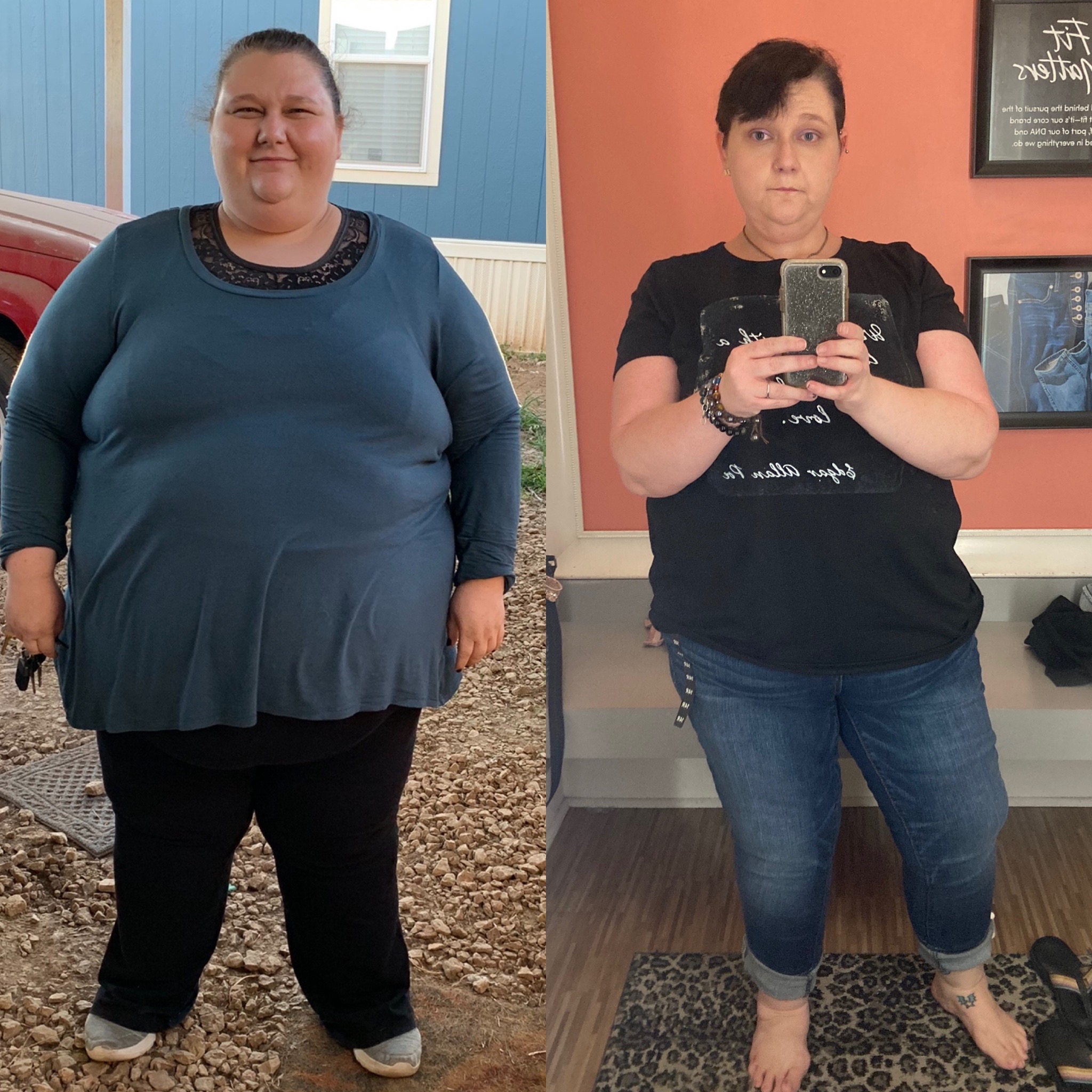
Evolution of my face post-surgery
As I mentioned before, I’m a binge eater. Food is my comfort. When things go wrong, I turn to food to cope. I was not prepared for the psychological ramifications of not being able to eat when I wanted to. For a while after surgery, I couldn’t even drink water. How would I ever get enough water and protein in my body? It’s a struggle. A daily struggle to this day. I remember back on those early days after surgery curled up in a ball, sobbing, “I just want to EAT.” I was so HUNGRY and then I wasn’t, bariatric surgery is weird like that.
When I finally could eat, I didn’t want to anymore. The surgery worked too well. However, as a binge eater, I had a hard time knowing when to stop and when I was too full, and I still struggle with that. I was right; my whole life changed. I lost 190 lbs., five clothing sizes, and the ability to eat most food for the longest time. Three years later, I still struggle with certain foods. Now, I must closely check what I eat and how much of it I eat.
412 lbs. versus 222 lbs.
In another previous blog, I wrote about grocery shopping on a budget. Today, I remain budget-friendly. I try to maintain a low-carb, high-protein diet as well as not eat over a certain number of calories. Buying in bulk and portioning out my meals in advance as well as limiting eating out keep me budget-friendly. 
All in all, I’m glad I had the surgery. My eating habits may have changed but I don’t have near as many health problems as I did before, I can walk long distances without having to sit and rest, and it’s a lot easier for me to find and buy clothes. Psychologically, I’m in a better place, and the need to binge eat gets less and less. Surgery is not for everyone, and not everyone has had the successes I’ve had with it. I’m thankful that I’m able to wake up every day and live my life how I want it.
Size 14/16 versus Size 30/32

I want to hear from our readers. Have you contemplated weight-loss surgery or have had weight-loss surgery? What were your successes and failures before and after surgery? Let’s continue the conversation here or on our Facebook group: MMC Chat.

Saturday, November 20, 2021

How We Grieve and Why It's Different for Everyone

Thanksgiving is right around the corner, and earlier this week, Amber opened a discussion on grief during the holidays. In our podcast, I shared a few things my family did to lessen the sadness of missing a loved-one during important family holidays, while Christen talked about working through a holiday, and Amber shared her personal experience with holiday grief on the blog. Dealing with grief is such an important topic that I wanted to dig a little deeper -- I want to continue the conversation about how people grieve and how we can help each other through the tough times.

Let us start by talking about what grief is, and how we experience it. Many people think that grief and mourning are the same thing, but they are not. Mourning is the outward actions that we take when we have a loss; grief is the internal thoughts and feelings we experience. Likewise, people often mistakenly attribute Elisabeth Kübler-Ross’s 5 Stages of Death and Dying to the stages of grief, but in fact, her research was about people dealing with their own deaths. According to psychologist and author Dr. J. William Worden, there really are no “stages” of grief because grief is not linear. His model is a set of “tasks” that a grieving person works through to find the way back to some level of function and normalcy. These tasks can occur in any order, or even concurrently. Sometimes, in the process of grieving, a person will go back to one or more tasks repeatedly. The tasks are:


The most important factor in this process is time, and there is no specific timeline for grief. Every person’s response to it is different and quite subjective. But the idea is to work our way back to a level of function as we move forward. Charles Jacob, a psychologist and teacher at Sacred Heart University, says, “Eventually, we just start trending back to normal.” He says that the real key is to get through the pain and then to derive meaning from all of it that “doesn’t leave us feeling completely hopeless.”

One of the best things, besides time, to help with grief is to share it. Experts agree that talking with friends and family, and telling stories about our loved ones is beneficial. It can even be helpful to talk to strangers, thus the growth of online grief support groups and the trend of pop-up “grief cafes,” where participants join a group of strangers over coffee, cake, and, of course, lots of talk about death.

WebMD’s “19 tips for coping with holiday stress and depression” includes tips like:
  • Make realistic expectations for the holiday season.
  • If you are lonely, try volunteering some time to help others.
  • Limit your drinking, since excessive drinking will only increase your feelings of depression.
  • Try something new. Celebrate the holidays in a new way.
  • Spend time with supportive and caring people or contact a long-lost friend or relative and spread some holiday cheer.
One group that has an especially difficult time with death and grieving is children. Kids of different ages deal with grief differently, and it is often done in spurts because their brains simply cannot tolerate more. Moreover, children will continue to grieve in different ways as they age and mature, continuing into their 20’s when their brains are fully developed. Mila Ruiz Tecala, LICSW, Center of Loss and Grief in Washington, D. C., tells us that when “children are not helped to grieve at every stage of their development, they experience cumulative losses.” Unresolved grief has been shown to create a higher risk of depression, unemployment, smoking, over-eating, lack of appetite, and risky behavior, and has links to immune disorders, hypertension, cardiac events, and cancer.

No matter the age of the child, the experts agree that it is important to make sure they know that it is acceptable to show emotions and talk about the person who died, and that it is okay to be sad.

To help children during the holidays:


If you have more tips on dealing with grief, we’d love to hear about it. Please join us as we continue this conversation in the Facebook group.

Thanks for sharing!

For more information about grief cafes, please visit the following websites:

Thursday, November 18, 2021

Alone for the Holidays

Hi everyone, it’s Christen here. This week, we have been discussing grief and loss during the holidays. Most of the time, when we think of loss during the holidays, we are considering those times when we lost a loved one due to death, or a relationship ended near the holidays. While I was thinking about this topic, I remembered a time when I was alone during the holidays, but it was not because I had lost a loved one; it just so happened that my work schedule conflicted and I was not able to partake in the holiday fun. It is not as heartbreaking, for sure, but it can really leave you down in the dumps. 

Being the work-aholic that I am, I tend to find myself already booked up and committed to work things during the holidays. I keep my nose to my keyboard often, and am always looking for extra ways to make an extra buck. With that being said, sometimes during the holidays, I am working two jobs if one comes available. One year, I had this awesome opportunity to work for Boston Market, a homestyle rotisserie chicken restaurant popular in my area. They offer a special Thanksgiving meal that can be preordered, and picked up ahead of time, even on Thanksgiving Day itself. Knowing that I had restaurant experience and call center experience, a family friend of mine had offered me a temporary position to follow up with the previous years customers offering them the opportunity to place their orders again. I was excited to take up this job and did it for several years. 


One year though, my little brother, Steven, was in college at Texas A&M and was not going to be home for Thanksgiving. His college always played a football game on Thanksgiving Day, and it is a big deal for Aggie fans to participate in the game. He was in the Corps of Cadets and they marched the field during halftime. The Aggie parents of the students have a huge Thanksgiving day tailgating party, and my parents were not going to miss this opportunity to join in on the fun! My parents made plans to head down south -- a 3-hour drive to celebrate with the other Texas A&M fans. I was not able to take time off from my job the day before to head down there with my parents, which left me home alone for Thanksgiving. 


At first, I was a little disappointed that my parents would “abandon me” for Thanksgiving, seeing as I had never spent that holiday without them, but I quickly got over that, because, let’s get real, it’s not all about me. Missing out on Turkey Day with my folks did give me the chance to decide what I wanted to do, and that really made me feel like an adult (I was in my 20’s - so you know, adulting was a new concept). At first I felt rebellious, and decided that I was not going to celebrate thanksgiving because I did not “have to” for once in my life. Then I decided that I didn’t want the day to go to waste, so I offered to work that day too! I ended up working on my very first holiday. If you have ever had to pull through shift work on a holiday, you know what it is like. There is almost like an extra special team spirit about it. Yes, you all look each other in the eyes and know that you are going to make it through this day, and muster through it, so you can get home to be with your family.


I am grateful for the experience that I had with my work family, and I never take for granted the fact that there are those out there that do end up having to work on the holidays, and I was especially happy the next year to be with my family again. I think next time, I may find other fun things to do besides working if I can help it!


Monday, November 15, 2021

Four Christmases

Hey this is Amber Garvin with my first official blog post and I’m here to talk about grief during the holidays. The subject is hard for me because I don’t have a family in a traditional sense anymore. Both of my parents have recently passed away, and I am newly divorced. So, in a sense,


“Grief is like the ocean; it comes on waves ebbing and flowing. Sometimes the water is calm, and sometimes it is overwhelming. All we can do is learn to swim.” – Vicki Harrison.


The holidays are coming, and it is not my favorite time of the year. In the past, I looked forward to November and December. Not just because I am a teacher and I get some much-needed time off work but also because I got to spend time with my family. I come from a very traditional family. On Thanksgiving, we had turkey and dressing at my Maw Maw’s house sitting around my great grandmother’s table eating family style. My family always had at least four kinds of pie on Thanksgiving as well. After dinner, we would play board games with football playing in the background. My mom, cousin, and I also have November birthdays, so we usually celebrated our birthdays on Thanksgiving as well.

Christmas was a big deal in my family also. Every year, we picked out a real Christmas tree from the local tree farm and we decorated it together as a family. I’m an only child so it was just my mom, dad, and me. Every year my mom and I also made Christmas cookies and candy together to wrap and deliver to extended family and friends. Christmas was my mom’s absolute favorite time of the year, and she went out of her way to make it special for everyone throughout the years. Her favorite thing to do (and she did this well into my adult life) was play the role of Santa for my dad, Maw Maw, and me. In the early hours of Christmas morning, she would fill the family stockings with various knickknacks and would place bigger presents under the Christmas tree. I remember the Christmas after I became a teacher, “Santa” surprised me with office supplies for my classroom. Around noon on Christmas Day, my whole family would gather at my Maw Maw’s house, and we would have a family gift exchange. These gifts were usually handmade, or food related of some kind. Food gifts were also a huge tradition in my family. Every year, my mom was always the one to pass out the gifts as well. The holidays were special.


My dad died in 2017 and in 2018 my mom died just a little over a year later. The Christmas after my mom died, I obsessively tried to fill her shoes as “Santa.” I went over the top with gifts and baking. In my grief, I tried to make it seem like there weren’t two giant holes in the holiday. In the year after my mom’s death, my ex-husband and I fell out with the rest of my family due to grief and differences of opinion. In 2019, I had decided to forgo the holidays and my then-husband, and I took my Maw Maw to a casual diner for a Christmas lunch. We didn’t exchange presents at all that year.


The last picture taken with both of my parents: Christmas of 2016


In 2020, amid the pandemic, I had a lot of time for clarity and self-reflection. I was finally able to deal with my grief over the loss of my parents. My ex-husband and I had also separated right before the holidays as well. 2020, was looking to be another year of holiday avoidance. At the same time, I didn’t want to avoid them. I was ready to take my grief head on and channel it into something more positive. The holidays are overwhelming as it is but adding grief to the mix can make them unbearable for most. In November of 2020, I began to make amends and my extended family was happy to welcome me back into the fold. Once I became open to trying new things, I realized that I wasn’t as alone as I thought.So, in 2020, I started new traditions with four Christmases. 


The key to coping with grief is to not completely abandon your old traditions. Last year, I decided to mix old traditions with new traditions to see where I would end up. The week before Christmas, I made around 200 Christmas cookies to wrap for family and friends, then on Christmas Eve, I began a three-day long trek across Texas to get my holiday groove back. 


I started in Carrollton with my Modern Musings family. Cindy and Christen have been inviting me to their family Christmas for years but this year I completely immersed myself into their traditions of gingerbread house building (my first one ever), Christmas caroling, and Christmas Eve pajamas. It was like we had been having Christmas together for years and I was grateful for the love that my Modern Musings family has shown me. Next, I went to my hometown of Vernon and spent Christmas morning with my childhood friend Stacy and her family. For dinner, I went to my cousin Stephanie’s house. I had not seen her and her family much after my mom’s death. Some of my extended family I was seeing for the first time in two years, but it was like I had never broken tradition. My family welcomed me back with open arms and open hearts. We had dinner, played board games, and exchanged food gifts. My cousin Steven even showed the family his new hobby of axe throwing, which may just become a new family get together tradition. Finally, I was invited to my extended cousin Lavonna’s house the day after Christmas for a family get-together that I have never attended. 


I went through many stages of grief in the years after my parents died and my marriage fell apart. For a long time, I was scared of new traditions and opted to avoid the holidays altogether. I realized that aside from hurting myself in avoiding the holidays, I was also hurting the extended family and friends that wanted to see me and experience their traditions with me. My takeaway is that it’s okay to start new traditions after tragedy. It’s okay to keep old traditions. It’s okay to combine traditions to whatever works for you. For the longest time I avoided the people that loved me because I was grieving, and I was being unfair to myself. I’m not sure what I will do this year for the holidays, but I take comfort in the fact that so many people have been there for me in the past year, and it makes me feel less alone and more hopeful for the future.


The holidays are hard when you’ve lost loved ones, but you are not alone. What are your favorite holiday traditions? Have you experienced the same things that I have? I want to know. Comment below or e-mail me at info@modernmusings.net.


5 Ways to Manifest Your Best Life

Hi there, and welcome back! Since we have been heavily focusing on goals and planning, I thought we should discuss manifesting. I love this ...