Looking at ourselves and the world through the lens of the 21st century.

Tuesday, April 12, 2022

Blackout Poetry For Everyone


In my recent blog, I mentioned that I was going to go into more detail about blackout poetry and the history of the subject. Blackout poetry is when you take a written piece of work, such as a newspaper or old book, and redact or blackout words to form a poem.

Blackout poetry seems like a fairly recent phenomenon but it has, in fact, been around since the 1700s! According to the article, “What is Blackout Poetry? A Brief History of the Form” by Sean Glatch, one of the earliest forms of blackout poetry was made by Caleb Whiteford by redacting newspaper articles and making jokes out of the words. However, the art form was lost and didn’t resurface until the Dada Movement (1915) and the Beat Poet Movement (1940). Blackout poetry didn’t become mainstream until a man named Austin Kleon published his first book of newspaper blackout poems in 2010.

Kleon’s book was not the first time I had heard of alternative forms of poetry. My love of poetry goes back to elementary school when I learned about limericks and haikus. Over the years, poetry has become an emotional outlet for me. My greatest influences have always been Edgar Allan Poe and Emily Dickinson. When I was in high school, I published my first poem in the “visiting artists” section of the yearbook. I remember making blackout poetry from old issues of the local newspaper in high school English class. 

I didn’t revisit the form until my first year of teaching when I was researching fun ways to teach poetry to students. I ran across Austin Kleon’s book Steal Like an Artist and fell in love with the art form yet again. During quarantine, poetry was one of the few things that kept me sane. I took an old copy of The Giver by Lois Lowery and began practicing my blackout poetry. My intention was to take an old book that I had multiple copies of and turn it into a blackout book. But before blacking out, I needed to actually create my poetry.

How to create a blackout poem:

  • Step 1: You need a printed form of media, a pencil, and a marker or paint.


  • Step 2: Find your anchor words. When you read through the page, use your pencil to underline the words or phrases that appeal to you.


  • Step 3: Find your filler words and underline them. These are the words that you use to string together your anchor words to create your poem.


  • Step 4: Box in your words. I like to draw a box around my words in pencil first and then go over the box with a sharpie pen, making sure there is enough room around the words for mistakes.
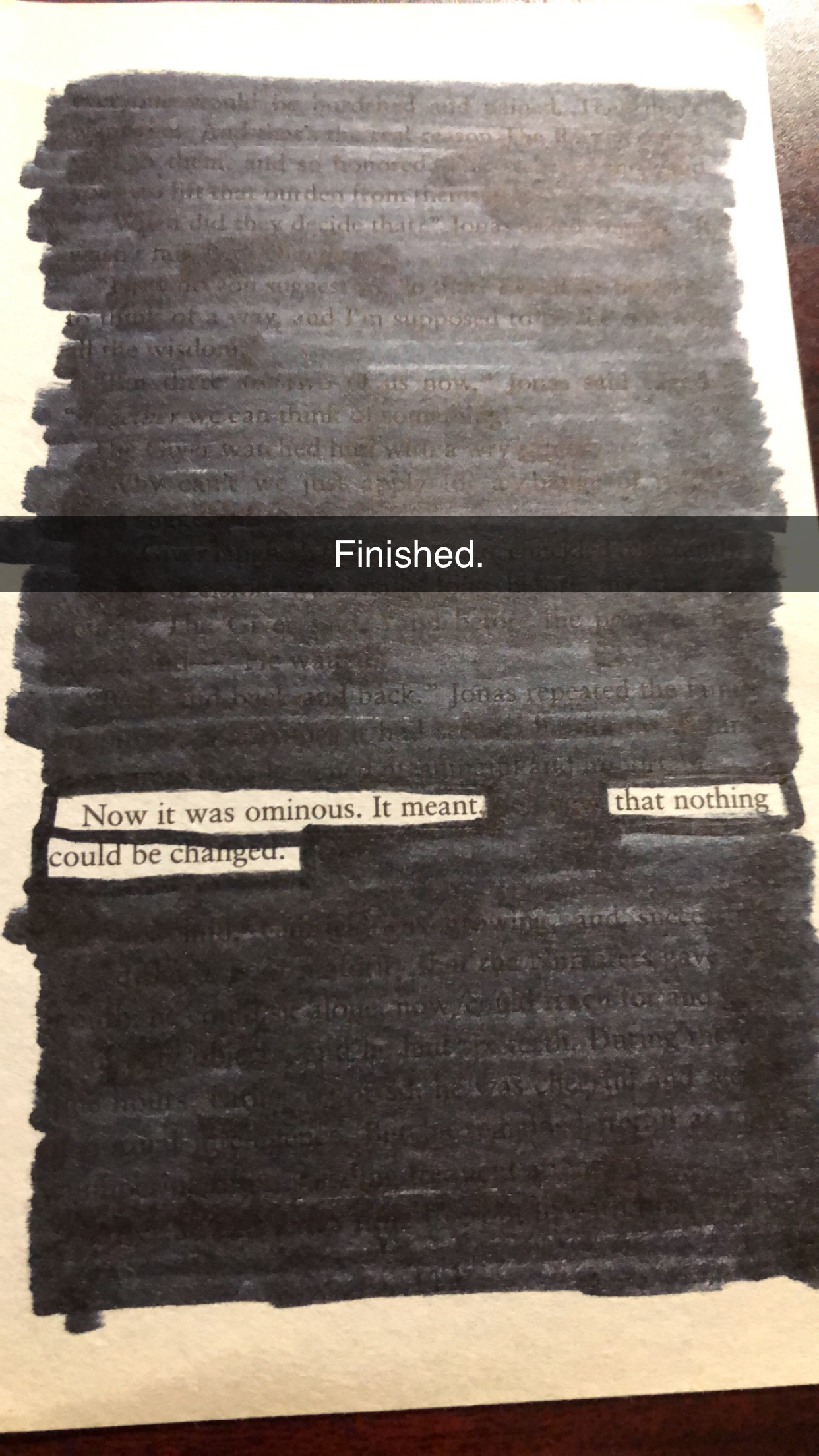

  • Step 5: Black it out. With your marker (preferably a darker color) or paint, begin to blackout all of the other words around your boxes.

Key things to remember:
  • There are no rules when it comes to blackout poetry! You don’t have to rhyme and it doesn’t even have to make sense!
  • It is okay to mess up!
  • HAVE FUN and enjoy yourself!

Voila! You have created your poem! Are you ready to take it to the next level?


How to turn your poem into art:
  • Blackout your words with different colors.
  • Make designs around your boxed-in words that are relevant to your poem.
  • Collage around your poem or add it to your Vision Board.
  • Turn your poem into mixed media art on a canvas.


When quarantine was over and retail stores started opening up again, I went to my favorite place in Dallas, the flagship Half Price Books, to search for the perfect book to create blackout poetry. In the clearance section, I found a copy of Mary Shelley’s Frankenstein with a gorgeous cover. My blackout poetry book is an ongoing project, and I made it a personal goal in my Powersheets® to finish it this year. Look for a follow-up blog in the future on my progress with Powersheets® and my personal goal-setting for the year.


I want to hear from my readers. Do you like blackout poetry? Have you ever tried to make blackout poetry? I challenge you to make your own blackout poetry and share it with us. Take a picture and upload it to our Facebook Group MMC Chat and let’s continue the conversation!

As an Amazon Associate, I earn from qualifying purchases.


Monday, April 11, 2022

Celebrating National Poetry Month

Hey everyone! It’s Amber, and this month is National Poetry Month. Something I like to do every year is celebrate my love of poetry with my students. For those of you that don’t know, National Poetry Month was created in 1996 by the Academy of American Poets and is now one of the largest literary celebrations in the world. On our podcast that is coming out this week, we discuss different types of poetry and some easy ways to make poetry, which will also be coming out as future blogs. I also talked about celebrating National Poetry Month in my classroom.

Student board celebrating National Poetry Month

When it comes to poetry, my students often get discouraged because they feel like they don’t understand what poems are trying to say due to the nuance of poetry devices. The first thing I tell them is that anyone can write a poem. I do this in two different ways: imagery and blackout poetry, and I frame my unit with these two things.


Ways I Celebrate National Poetry Month in my Classroom:
  • Imagery Poem: Imagery is “visually descriptive figurative language using the five senses.” Before we even talk about poetry, I have my students write about their favorite food using each of the five senses: see, touch, hear, smell, and taste. This is usually a five-minute beginning of class activity and I remind them not to overthink it, to write the first thing that pops up in their head. You can find my lesson here.
  • Lyric Poetry: I once took a class on the best ways to teach poetry from Laura Randazzo and I still use many of her techniques in my classroom to date. She suggested comparing and contrasting modern songs to older-style songs. My favorite comparison is "Stereo Hearts" by Gym Class Heroes (2011) and "My Love is Like a Red, Red Rose" by Robert Burns (1794) because they are using similes and metaphors to compare love in their lyrics. This leads me to my first project.
  • Figurative Language in Song Lyrics: After comparing songs and studying different styles of lyrical poetry such as sonnets, psalms, dramatic, and ballads, students must showcase a type of poetic device using song lyrics. They get to present/or read their findings to the class and explain in a presentation how what they choose is figurative language and what it means. This is a fun project for my students because they get to listen to music and examine their favorite songs more closely.
  • Rhyme Games or Poetry Slam: I do this when I teach my 9th Grade “Sonnets”. As we mentioned in the podcast, sonnets are a bit hard to follow if you don’t understand Shakespeare or rhyming. This game can also easily turn into a poetry slam because Shakespeare’s sonnets are a lot like rap music. I use "Sonnet 18" by William Shakespeare, and I read it really quickly to my students like I am rapping it, and then I show them a parody of the same poem by an unknown writer on my Sonnet Worksheet and challenge my students to write their own parodies. If they have trouble rhyming, I direct them to RhymeZone.
  • Alternate Forms of Poetry: I like to teach my students blackout poetry, which I will go into detail about in a future blog. I also like to teach students about found poetry, which is similar to blackout poetry, and book spine poetry (pictured), which is made by stacking books on top of each other in different ways. These are some of the simplest ways to make poetry.


Book Spine Poetry


  • Poem in Your Pocket Day: On the upcoming podcast, I also mention “Poem in Your Pocket Day” which will take place this month on April 29th. The idea is to take a small poem that fits in your pocket and make that your poem for the day. The Academy of American Poets has a few suggestions on how everyone can celebrate National Poetry Month such as drawing an image of your chosen poem, recording yourself reading it and uploading it on social media, or making an origami sculpture out of the poem. I uploaded a PDF of their suggestions here.

Poem in Your Pocket

I encourage my readers to not be intimidated by poetry because everyone is a poet, even if they don’t know it. Explore poetry with some of my suggestions above, and when you are ready, give some of my favorite classics a try (listed below). Let’s continue the conversation on our Facebook Page and our Facebook Group MMC Chat.


Some of My Favorite Classic Poems:


As an Amazon Associate, I earn from qualifying purchases.

Sunday, April 10, 2022

Everyday Tasks

Let’s face it – cleaning is hard. It’s hard especially if you have Attention Deficit Hyperactivity Disorder (ADHD) and Obsessive-Compulsive Disorder (OCD). It is like the angel and devil on your shoulder. My OCD says, “Clean,” and my ADHD says, “Do Everything But….” That is why I need to have a cleaning checklist.


In my last blog, I talked about my tendency to hoard and how difficult it was to move to a new place. What I didn’t talk about was how cleaning my old place after I moved was a nightmare. I had two years' worth of cobwebs on my ceiling, two years of dust on my blinds, and two years of grime on my baseboards. When I moved to my new place, I vowed to never my place get that dirty again and I resolved to make an effort to keep my house clean, if anything, to be able to invite company over.

Because I struggle so much with consistency, I try to keep a daily checklist of things that I need to do for that day on my fridge. Not all the things on my checklist are cleaning-related. I have the simplest things on there such as “drink water” because I find that I have to constantly remind myself to do things. I’ve tried cleaning my house in a variety of ways over the years but I find it best if I complete one task every day and I do that task immediately after I get home from work or I will sit down and all will be lost.


  • Sunday: Laundry and Vacuum Day. I do this simultaneously between laundry loads.
  • Monday: Kitchen Day. I typically run the dishwasher, clean my counters, and stove, and clean out my fridge on this day.
  • Tuesday: Bathroom Day. I typically clean most of my bathroom this day. I clean my shower daily as I shower. This is a hack I picked up from TikTok (featured on ThisYouNeed).
  • Wednesday: Miscellaneous Dusting/Clutter Day. I typically try to lightly dust my bookshelves, window sills, and blinds for cobwebs if needed. I also try and go through any clutter that is amassed during the week and get my trash ready to be taken out.
  • Thursday: Date Night/Rest Day. Jason is off on Thursdays so we typically have our date night on Thursday.
  • Friday/Saturday: Deep Sweeping Day/Deep Cat Box cleaning. Caring for cats is almost a daily task but I typically wash out their cat box at least once a week. Over the week they also tend to get litter on the floor in the area of their cat box or track it across the house.

My cleaning checklist isn’t perfect and I don’t follow it 100% every week but I have lived a much cleaner existence since I have implemented it. I want to hear from our readers. Do you have a cleaning checklist? What do you do to make your life easier when cleaning? Continue the conversation on our Facebook Group: MMC Chat.

Thursday, April 7, 2022

My Household Tending List

Hi there! It’s Cindy again. I hope you enjoyed our podcast yesterday about cleaning checklists. As I mentioned in our discussion, I think checklists are a great idea, and I have been using them to help me get through all my chores for a long time. Let’s face it…we’re busy! We have jobs, kids, spouses, boyfriends, hobbies, and so much stuff that we have to take care of at any given time that some of that stuff tends to fall through the cracks. That’s why I created a monthly checklist that I put in my day planner.


My current household checklist

I call this checklist my “tending list” because it goes along with my PowerSheets® tending list.  Whenever I check one, I automatically check the other. It’s a great form of accountability for me because I love filling in all the little squares (an OCD thing from childhood), and I feel so accomplished when I look at them and see that I’ve accomplished a lot. My list has far more than just cleaning tasks, as I’ve included some work, health, and family items on it as well. There are a few items I’d like to add to it, but it works for me so far – maybe next month.


My list started several years ago as a bujo (see bullet journal) entry, but I prefer having it in my Happy Planner with all my other tasks. My early planner lists were all drawn by hand onto the opening page of each month and I arranged everything to fit in the space available. It was also a very short list compared to the list I use today, so there’s nothing that says your list has to be as long as the one I use. If you make a list, make sure that it works with your goals and the items you want to track. 


My first household tending list - January 2021

By December it had evolved to this

In January, I started my new Happy Planner® and was surprised to see that the format of the opening page for each month had changed significantly and that my old checklist layout didn’t work anymore. So, I rearranged the list and again drew it by hand, but because it was no longer on a dot-grid paper, drawing it out took significantly longer than the old design and I abandoned that effort the very next month. Instead, I scanned the January list before I filled in all the text, and now I just run the planner page through my printer. I’ve used a similar technique for other pages in my Happy Planner (more on that in an upcoming episode!), and the printer handles the disc-punched pages just fine. I’d also like to note that I do use a “White Out” correction tape on a small section of the page, and since my printer is a laser printer, it prints over it just fine. I do not know how an inkjet printer will react to the whiteout, so your mileage may vary. I’ve linked both my printer and the correction tape below.

The blank file that I print onto my planner page


Add Amazon links to Happy Planner, my printer, favorite pen, and correction tape. Creating your checklist in a bullet journal or notebook can be fun if you like to do such things…I’m a list-maker at heart, and I love any excuse to make a list! But for those of you who aren’t, or you’d like a quick start on a list of your own, I’ve included a link to a blank version of my checklist below. I’ve offered a bundle that includes a JPEG, PDF, and PSD (Photoshop) version. If you have any questions about how I use it, please feel free to drop me a line using the email form on the right, leave a comment below, or even contact me through our Facebook page or MMC Chat group. 


Download the Checklist Bundle


Products I've mentioned in this article:


As an Amazon Affiliate, we earn from qualifying purchases.

Wednesday, April 6, 2022

Heard It on the Podcast - April 6, 2022


Did you miss a link we mentioned on the podcast? Here's a quick post we'll do every Wednesday to share any links or information from the podcast. We'll also keep a running post on the "Links from the Podcast" tab so you can refer back to any previous episode. Here's the links for this week:

6-APR-2022
S2E15: What's on Your Cleaning Checklist?

There is a correction to a statement made on the podcast. We mentioned a series called "1800 House", but in fact, the name of the series was "1900 House". We have included a link to stream the series below. The other show we mentioned was "Pioneer Family", however we couldn't remember the name. It is linked below as "Frontier House".

* *Please note, as an Amazon Affiliate, we earn from qualifying purchases.

Monday, April 4, 2022

A Simple Cleaning Checklist for Anyone

Hi there, it’s Christen - Happy Monday! It is springtime, which always makes me feel perky and motivated. This year, I set a goal to manage my household more efficiently. Effective communication with my husband, Travis, has been a challenge due to our schedules. I wanted to find a way to make it easier for both of us to access important household information without having to call each other during work hours. I also wanted Travis to have the knowledge at his fingertips to effectively manage the household without me guiding or micro-managing him. I decided that a “Home Binder” was necessary, and set a goal to create one as part of my Cultivate What Matters tending lists and 2022 goals. I may have mentioned my home binder and some of its contents on the podcast a few times and hope to provide an update on my progress here on the blog soon. Be on the look out for that!

Among the sections that provide helpful information in the binder is one for household maintenance. By maintenance, I mean cleaning, seasonal care, repairs and services. This time of year, I have many of these processes in mind, especially the routine and seasonal cleaning. As a newly married couple, we have learned what each other’s strengths are and where we can give each other support. Although my husband knows how to clean up after himself, he does not know all the ins and outs of sanitizing and deep cleaning. I wanted to give him an idea of when each of these tasks should be completed, and with what chemicals and tools. 

Getting married and some drastic changes in my work schedule has changed most of my routines. I simply can’t count on using one of my days off to do all the laundry, cleaning and meal prepping and still make it to bed at a decent hour. I went back and forth trying to set up a new routine and struggled with sticking with it. Thankfully, my husband and daughter are willing to help around the house, and the chores do not all fall on me. 

In order to ensure that all the necessary tasks are completed in a timely manner, I decided to compile a master cleaning list. Since my brain has been conditioned to think in monthly, weekly, and daily tasks thanks to my Cultivate What Matters tending list, I decided to drop my previous weekly cleaning schedule and opt for a more flexible checklist. 

In the free download, you will find a cleaning checklist broken down into the three groups outlined below:

  • Daily - Action items that should be completed every single day, like washing your dishes, taking the garbage out, making your bed, and tidying up.
  • Weekly - Action items that need to be performed once per week and can either be done on a specific day or any time during the week. For example, the garbage can needs to be rolled out to the curb every week on the same day, and you will be sorry if you missed it. Vacuuming however can probably happen only once per week and you can often live with going one day longer if needed.
  • Monthly - Action items that only have to be completed once per month, usually around the same time each month. For example, it's a good idea to dust the ceiling fans, but no one is going to suffer if you don’t do it exactly on the “first Friday of the month.”

My cleaning schedule might not be frequent enough for you, or might even be more than you want to commit to, but it should at least give you some ideas on how to create your own schedule. As I mentioned above, I’ve linked a free one to download for your own use - I encourage you to make it your own! I saved it as a WORD .doc so that you can edit it to your liking. Is there something that I left off? I would love to know what you think! Please don’t forget to come over to our Facebook chat group, and be sure to listen to the podcast on Wednesday when we’ll continue the conversation.

Saturday, April 2, 2022

This week on the podcast, we talked about clutter and its tendency to collect in our homes. We had some fun laughs about the reality of our messes, too! I was inspired by our talk and the information provided from my www.Clutterbug.me results. I wanted to share my before and after pictures of my Clutterbug project – my kitchen.

Travis and I still had a box in our kitchen from when we moved almost 10 months ago. I was fed up with looking at that box one day, and unloaded it onto the kitchen island. The idea was to identify what was in the box and then put the items away, but I ran out of time to find a new home for these last straggling items, so they stayed in that spot. Now they were sitting on the catch-all, an already cluttered problem area of my home. 

The clutter got so bad, we could no longer work at the kitchen island, and complacency had become the norm. Each day, one more thing wound up on the island and did not leave. My husband even started leaving the groceries out; instead of putting a can in the pantry while unloading the groceries, the can would find its new home on the island. 

Clutter stacking up on the Kitchen island and inside the cabinets.
Clutter stacking up on the kitchen island, inside the cabinets, and "the box".

Since the Clutterbug quiz suggested storing things in clear containers, I got these acrylic bins from amazon. Unfortunately, I did not measure my cabinet space (whoops), and the bins are too big for my pantry. I was able to use a few of them around the kitchen, and I will get some smaller ones for the pantry. I can use the remaining large ones in my craft room. 

This week I worked a lot of overtime at work, so I haven’t had as much energy or time to dedicate to my organizing. I did however decide to organize the cups though. The clutter was persistently on my mind after I had mentioned them in an earlier blog. The nice thing about spring cleaning is that it doesn't have to be done all at once. In fact, the best thing to do is one small area or task at a time. There are a few areas that got worked over that I didn’t capture with my camera – mainly the pantry. I tossed out a lot of half eaten cracker sleeves, stale cookies, old protein bars, and random odds and ends that were taking up space. 

I'm happy the way the catch all areas turned out.

For the near future, I have plans to clear out the utensil drawer and utilize the empty cabinet space above the fridge, but I know that it will be little by little. I don’t want to try and do a total overhaul on the kitchen all at once, which would wreck a major working area in our home. Next up after the kitchen will be my dressing table where there are a slew of cosmetics, hair products, earrings, and misc. items strewn about. I am really looking forward to that much needed project.

Have you had a chance to check out the Clutterbug quiz to see what type of Clutterbug you are? I’d love to hear about your style! Maybe you can share some tips in the comments! 

Thursday, March 31, 2022

Out With the Old

It’s the summer of 2014 and I’m standing in the house I grew up in amongst the trash and remnants of my childhood. I feel sadness about the years of neglect as the last of the boxes are hastily packed in a moving truck and carted off to storage. When does a bit of clutter turn into the tendency to hoard?

Hoarding is the difficulty of parting with possessions because of a perceived need to save them. When we think of hoarding, we often think of the popular television show that airs on A&E. Those, of course, are extreme cases of hoarding. I never thought that it could run in my family. However, according to Psychiatry.org, hoarding does run in the family, and I fight my tendency to hoard constantly because I love to shop. That summer, my dad was downsizing from a three-bedroom house to a two-bedroom apartment, and I discovered that my parents kept everything. They never threw anything away. As I was going through 20-year-old bills and throwing away food that was years out of date, I thought to myself that I would never become a hoarder to this extent.


Boy, was I wrong!

At the time, my mom explained to me the sentimentality of 40 plus years of marriage, and how one just “collects” things over the years. Yeah, I got that, but I only had a few possessions that I could never get rid of. I will admit that I am a book hoarder; I’ve kept every book that I ever read, and carried every book (including a dictionary collection) with me every time I moved once I turned 18 – and I moved every two years. I couldn’t fathom hoarding bills and receipts as my mom had done. I regularly shredded my mail. I have never been a fan of clutter, but it was something I dealt with growing up. I always remembered our house being so full of things that it was oftentimes hard to walk through.


As an adult, I thought I was done with the clutter and the hoarding, but then I married a hoarder. I didn’t realize it at the time, but my ex-husband did little things that bothered me, like never throwing away trash, and it reminded me of my dad in the sense that he didn’t throw away trash either. They say women tend to marry their fathers, and I felt like I was always picking up after both of them. Throughout our relationship, my ex and I also began to pick up clutter and possessions. After we moved from a three-bedroom house to a two-bedroom, I realized that we had become hoarders. We kept everything that anyone had ever given us, and it was hard to neatly organize our living space.

When quarantine hit in 2020, I suddenly had to teach from home, and I found I had no space in which to even set up a desk. My ex-husband and I had so much stuff that we were navigating through little trails to get through our house and the piled-up boxes. Deja vu. After our separation, I made some SMART goals that would get me through 2021 and one of them was to get rid of the clutter.

Christen gave me some sage advice when I started the process. She quoted Marie Kondo, “look at everything and ask yourself, ‘does this make me happy?’” So, I did. It took me three months and about 10 trips to the thrift store to downsize my life after my divorce. I went through every possession I owned and considered whether it made me happy. When I was done, I no longer felt like a hoarder. I felt great…accomplished.

So, why does getting rid of stuff feel so good?


According to the article “Why Getting Rid of Stuff Feels So Good” by Shifrah Combiths, there are several reasons why getting rid of stuff makes us feel so good, but the reason that resonates with me the most is that “separating from the past can heal” and that is what I did. I hung on to so many things because there was a sentimental value attached to them. I didn’t want to get rid of certain things because “my mom gave it to me” or “my dad used it” at this certain time. But, I realized that possessions aren’t memories, and I can still keep the memories of my parents within me without keeping every single thing that they owned. That, in itself, was freeing.

So, whenever I tend to hoard or my house gets to the point where the clutter is out of control, I remember that moment I had eight years ago when I realized that there is such a thing as “too much.”

Are you a clutter bug? Are there things that you keep and you don’t know why? Let me know in the comments, and let’s continue the conversation in our Facebook Group.

You can find Marie Kondo’s website here.

Wednesday, March 30, 2022

Heard It on the Podcast - March 30, 2022


Did you miss a link we mentioned on the podcast? Here's a quick post we'll do every Wednesday to share any links or information from the podcast. We'll also keep a running post on the "Links from the Podcast" tab so you can refer back to any previous episode. Here's the links for this week:

30-MAR-2022
S2E14: What Kind of Clutterbug Are You?
* Please note, as an Amazon Affiliate, we earn from qualifying purchases.

5 Ways to Manifest Your Best Life

Hi there, and welcome back! Since we have been heavily focusing on goals and planning, I thought we should discuss manifesting. I love this ...