Looking at ourselves and the world through the lens of the 21st century.

Showing posts with label weight loss surgery. Show all posts

Saturday, June 25, 2022

Why Bariatric Surgery is Not the Right Choice for Everyone


It’s not an easy fix. There…I said it. I can’t count the number of times someone has talked about bariatric surgery and referred to it as the easy way to lose weight. I’ve heard it from skinny people, overweight people, people who lost weight “the hard way”, and even people who’ve had the surgery. And I know a lot of people who have struggled to lose weight through diet and exercise, only to fail over and over again, so they see bariatric surgery as their last resort to losing weight, only to see it fail, too.


Did I mention it’s not an easy fix? Because it’s not. There are many different options for bariatric surgery these days, but even from the original days of the gastric bypass down to the now fashionable gastric sleeve, the choice to have this elective surgery is a hard one. Most surgeons and weight loss clinics require patients to go through intense screening before surgery. Nutrition counseling, psychological evaluations, and diagnostic sleep studies are just a few of the pre-op requirements. One friend had to produce records proving she had been attending regular Jazzercise classes for a certain length of time before her surgery. Patients must also start the process of altering their diets to shrink their stomachs and to prep for the kinds of foods they will be limited to once they’ve had the surgery.


One of the reasons I chose not to have bariatric surgery is that I just don’t think I can give up so many foods I love. For instance, bariatric patients can’t have carbonated beverages, like sodas, beer, or champagne. I’ve known people with older surgeries (like gastric bypass) who could not have bread or peanut butter. I can’t imagine never having another peanut butter sandwich for the rest of my life, much less giving up my beloved Coca-Cola…it was all I could do to make myself switch to Coke Zero when I found out I was diabetic. In addition to the foods bariatric patients must give up, there are many things they can’t eat anymore, like spicy food, greasy food, and often beef…all things I love.


Bariatric patients have to eat very tiny meals, but even when they eat all the right things in the right amounts, sometimes they still get sick. Some patients are sick more often than they are not. The surgery and the ensuing dietary changes often cause gastric distress, dumping syndrome, gallbladder attacks, pancreatitis, intolerance of foods they used to love, and even changes in the patient’s blood sugar levels. To make it worse, some well-intentioned patients go right back to their old eating habits, eating all the greasy fried food, carbs, and bubbly soft drinks that made them overweight in the first place simply because they haven’t addressed the real issues of their eating disorder.


In order for a bariatric patient to realize success after their surgery, they absolutely must change the way they think about and react to food. Have you ever heard the saying, “What got you here won’t get you there?” It’s absolutely true. You cannot fix a problem with food by continuing to eat the same things you ate before. A successful bariatric patient (or any weight loss practitioner, really) must come to terms with the mental muddle that caused them to gain weight in the first place, and they must change those patterns permanently. And that is no easy feat. If it was, we would all be a healthy weight.

I’ll admit that I am no expert on weight loss (see that last sentence in the previous paragraph), but I’ve seen enough people get on and off the bariatric merry-go-round to catch on to what many of them do right (and wrong), so I’d like to pass on my best tips for weight loss, and please don’t judge me by the fact that I have a hard time keeping to them myself.


  • Small portions rule. A bariatric patient often has a stomach about the size of your fist, so if you are eating more than that, you are probably stretching out, and thus undoing all the hard work your surgeon did to help you lose weight. Stop it. Go back to the small portions you started with and don’t go back to your old eating habits.

  • Nix the greasy fried food, high carbs, and empty calories. It’s really hard on your digestive system, and this is the junk that made you gain weight in the first place. Stick to nice, healthy proteins and veggies. If you can’t remember what healthy meals look like, go back to your nutrition counselor and get a list or examples.

  • Say no to soft drinks, beer, and anything bubbly. This stuff may taste good, but it often has empty calories, and the carbonation can actually expand your stomach that you just paid that doctor to reduce. If you absolutely have to have the taste of a Coke, let it go flat and be sure to choose a zero-calorie version.

  • Stop eating out. Yes, you read that right. Stop. Eating. Out. Restaurant food is over-portioned, high-calorie, high fat, high carb and just wrong, wrong, wrong for anyone trying to lose weight. Yes, I see that mile-high pile of chicken and waffles. Just no.

  • Get some accountability. Find a friend who is trying to lose weight, too, and then hold each other’s feet to the fire. Seriously. When you have an accountability partner who has the same goals as you, it will facilitate making the right choices. You can celebrate your wins (even the little ones) and you can talk each other down from the ledge.  Just be sure not to choose an accountability partner who will enable your bad choices. Let them know you expect them to tell you “no” and to remind you why you want to make the right choice.

  • Keep a food journal. Document everything you eat and drink. But don’t stop there. While you’re at it, stop a moment and think about why you ate what you ate. Was it a craving? If so, what prompted it? Was it an impulse? What was the trigger? Was it because you had too many choices, or even too few? Really account for what you eat, how much you eat, when you eat, and why you eat. You might be surprised to find some patterns in there, and a pattern is an opportunity to change.

  • Remember why you chose to have that surgery and to lose weight in the first place.  It was a hard choice and the path here has not been easy. Remember what you dreamed of when you started this journey – a healthy mind in a healthy body. So, every time you need to make a choice about food, ask yourself, “Is this in alignment with the life I want to live? Does this get me closer to or farther away from my goal?”


I hope that those of you who have elected to have bariatric surgery will find some help in these tips, and if you are considering bariatric surgery, that you will talk with your doctor about the many facets of weight loss surgery. It’s not just a decision to make a permanent physical alteration to your body…it is a life-long decision to live, eat, and think differently about food. It won’t be easy, but it does work…if you do the work.


Have you had bariatric surgery, or have you contemplated it? If you’ve had it, has it worked for you, or did you have early success and then struggled to continue? I’d like to hear about it. You can comment here, or join us over on the MMC Chat group.


Monday, June 20, 2022

Bariatric Struggles


This week on the podcast we are talking about eating bariatric-friendly on a budget. This is a topic near and dear to my heart. As I mentioned in a previous blog, I had bariatric surgery a little over three years ago and it hasn’t been easy because while I was going through surgery, I was also struggling mentally and financially.
That doesn’t seem like great timing to have a complicated surgery, I know, but the surgery was years in the making. In 2014, I noticed that something wasn’t right with my belly button, it was sticking out. I didn’t normally have a belly button that stuck out. After a trip to the doctor, I learned I had an umbilical hernia that had burst through my abdominal muscles. Because of my weight at the time (around 360 lbs.), the doctor told me the surgery was unsafe, and he suggested that I have weight loss surgery to lose weight quickly. As a teacher, weight loss surgery is covered (to a point) by my insurance if it is a medical emergency. So, I began the long process with my insurance. 
While waiting for my insurance, my hernia decided it could not wait, and it burst on me in the middle of class one day. One minute I was teaching and the next I was on the floor – it happened that quickly. I was rushed to the local hospital and had emergency surgery. So, I put off the process of weight loss surgery; aside from being overweight, I was healthy. Over the next few years, I maintained my weight until the summer of 2017 when two major things happened. First, I broke my foot and ended up in a wheelchair, and second, my father died.

After my dad’s death, my depression set in and the two years that followed were some of the hardest of my life. I retreated from everyone I loved and began deliberately working long hours so that I wouldn’t be home. I started secretly binge eating again to cope with my pain in silence. I was confined to my wheelchair for months because my foot was not healing properly due to a vitamin D deficiency. Due to my binge eating and lack of activity, I started gaining weight. At the same time, my husband was struggling to find and keep work, which added to my stress.

Then, in the fall of 2018, tragedy struck again with my mom’s death.  Both of my parents died of weight-related illnesses with the underlying cause of those illnesses being diabetes. I sat there numbly as family member after family member told me that I needed to take care of myself. Then one day my clothes didn’t fit anymore, my hip would pop out when I tried to put on pants, walking short distances made me way too tired and hurt my still-tender foot, and I realized that they were right.  Before my mom died, she had been advocating that I start seeing a doctor to restart the process of bariatric surgery. I was diagnosed with high blood pressure and pre-diabetes right before her death. My weight clocked in at over 400 lbs. I needed to change. So, I began the process, again.
When preparing for bariatric surgery, patients typically go through a psychological evaluation. My psychologist at the time questioned whether I was ready for surgery given all that I had been through. In all honesty, I probably wasn’t. My life, at the time, seemed in shambles. Both of my parents had died, my husband was struggling to find/keep work, finances were low, and I was also having problems of my own at my job. But I was determined. Maybe I needed something I could control in my life. Maybe I thought losing weight would solve all my problems. Whatever the reason, I soldiered on.
Many people think you save money on food after bariatric surgery, which is not the case. My doctor put me on a strict pre-op diet three weeks before surgery. Not only did I have to drink a certain amount of water per day, but I also had to drink a certain amount of protein per day. There are many different types of weight-loss protein on the market. You can either buy protein powder or already-made shakes. Either way, they are not cheap. For me, it was also hard to find a protein that I liked the taste of. Before surgery, I settled on a fair-priced protein powder called Syntrax Matrix and a liquid protein called Premier. I also stocked up on plenty of clear liquids for my post-op diet. When my surgery date came in April of 2019, I was ready to make that major change in my life. Or was I?
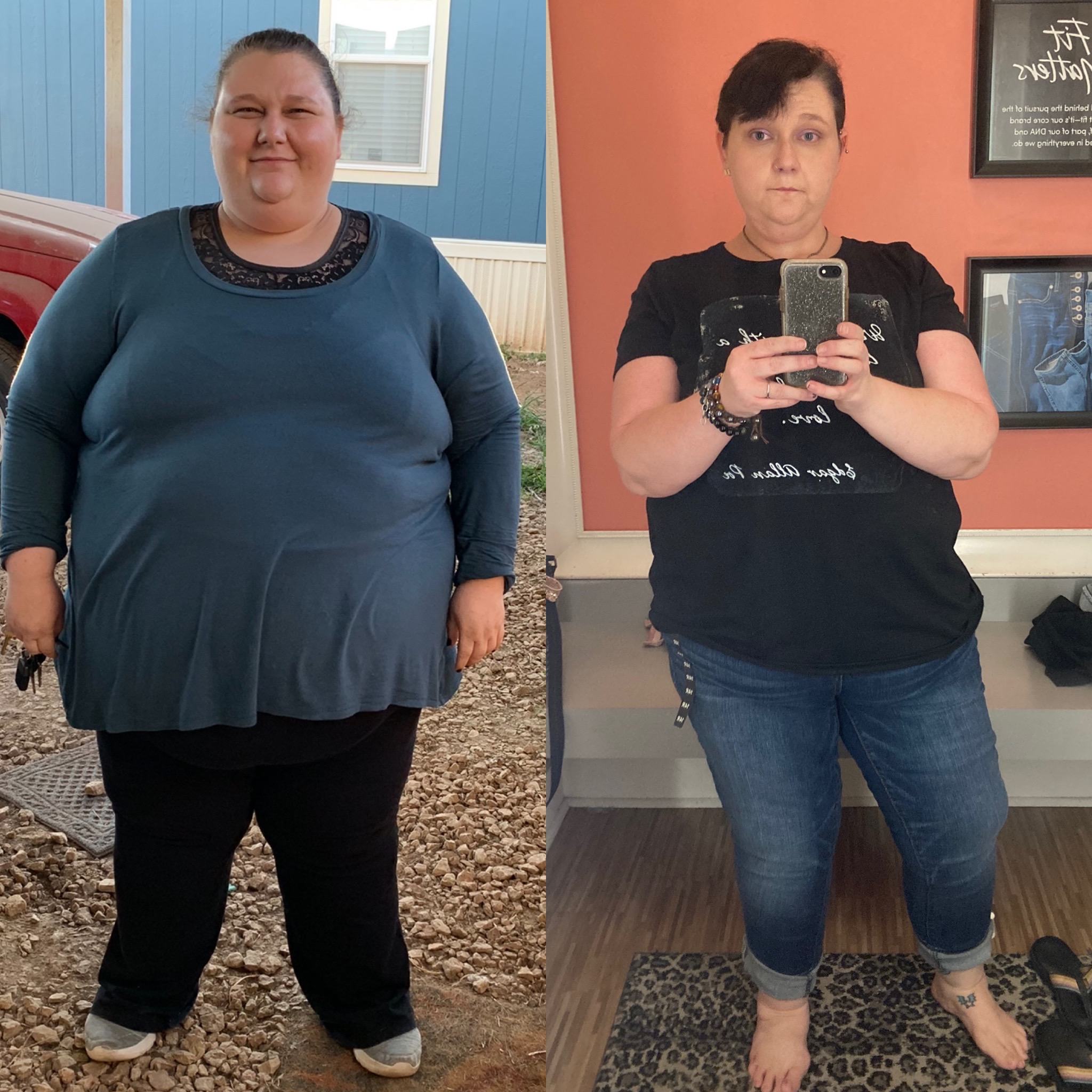
Evolution of my face post-surgery
As I mentioned before, I’m a binge eater. Food is my comfort. When things go wrong, I turn to food to cope. I was not prepared for the psychological ramifications of not being able to eat when I wanted to. For a while after surgery, I couldn’t even drink water. How would I ever get enough water and protein in my body? It’s a struggle. A daily struggle to this day. I remember back on those early days after surgery curled up in a ball, sobbing, “I just want to EAT.” I was so HUNGRY and then I wasn’t, bariatric surgery is weird like that.
When I finally could eat, I didn’t want to anymore. The surgery worked too well. However, as a binge eater, I had a hard time knowing when to stop and when I was too full, and I still struggle with that. I was right; my whole life changed. I lost 190 lbs., five clothing sizes, and the ability to eat most food for the longest time. Three years later, I still struggle with certain foods. Now, I must closely check what I eat and how much of it I eat.
412 lbs. versus 222 lbs.
In another previous blog, I wrote about grocery shopping on a budget. Today, I remain budget-friendly. I try to maintain a low-carb, high-protein diet as well as not eat over a certain number of calories. Buying in bulk and portioning out my meals in advance as well as limiting eating out keep me budget-friendly. 
All in all, I’m glad I had the surgery. My eating habits may have changed but I don’t have near as many health problems as I did before, I can walk long distances without having to sit and rest, and it’s a lot easier for me to find and buy clothes. Psychologically, I’m in a better place, and the need to binge eat gets less and less. Surgery is not for everyone, and not everyone has had the successes I’ve had with it. I’m thankful that I’m able to wake up every day and live my life how I want it.
Size 14/16 versus Size 30/32

I want to hear from our readers. Have you contemplated weight-loss surgery or have had weight-loss surgery? What were your successes and failures before and after surgery? Let’s continue the conversation here or on our Facebook group: MMC Chat.

Saturday, May 28, 2022

An Uncomfortable Topic

 When I think about the term “weight loss”, I don’t think about the physical transformation that a body goes through. I think of the mental anguish that I have been through in the past. I would not say that it has been traumatizing, but in a way, all of the time spent stressing or feeling bad about my failures with weight loss compiled together can be considered trauma. I don’t think that I suffer from any type of PTSD or anything like that, but I can say that the term, for me, holds a mental association with discomfort and pain.   

Losing weight seems to be the never ending journey that I have been on since I was in third grade. I remember getting my blood work done as a kid, they wanted to make sure I did not have diabetes, as Type 1 and 2 run in my family. I remember my grandmother and my mother being on a diet, and they encouraged me to diet as well. 

Among many of the fad diets and exercises I have tried, two stick out the most in my memory. I remember being on the Richard Simmons Deal-A-Meal diet. He had a system where foods had a color-coded card, and you had a wallet that held your daily food cards. As you consumed certain food, you would move the cards over to the other side of the wallet so that you could keep track of the foods that you ate. I have even been a member of Weight Watchers on multiple occasions. When I was younger and not an official member,  My grandma would photocopy all the reference materials and we would scour the menus of various restaurants together, looking for the meals with the best points.


At some point, I decided that I wanted to have weight loss surgery. I was tired of dieting and failing. I had seen people have great success after their surgery, and I wanted that. I felt that it was my last resort. I researched the different types of procedures, went for the consult, and decided that it was the right option for me. I went to a dietician for 6 months , but even the dietician struggled to find ways to help me lose weight. Once I fulfilled that requirement, along with a psych evaluation, I was approved for the vertical sleeve gastrectomy. 

My surgery was a great success…at first. I had lost about 25 lbs prior to my surgery, and then after surgery, my total loss was up to 90 lbs. I got very close to being under 200 lbs! Then COVID hit. I stopped going to the gym, and my daily steps decreased because I was only moving around in my tiny apartment. I gained some of my weight back, mostly from stress snacking. Since then, I’m back to trying to lose weight again and struggling. 


I guess you could say that it is a sore subject with me. I have tried just about everything from counseling, dieting, and even surgery, but still find it a major challenge in my day to day life. It is really something that I do not enjoy talking about. I find that I'm a lot happier when I am not worried about my weight or trying to lose it. 

I’m sure that many can relate to me. I would love to hear your struggles and successes. We can commiserate and celebrate together! Be sure to check us out on Facebook.

5 Ways to Manifest Your Best Life

Hi there, and welcome back! Since we have been heavily focusing on goals and planning, I thought we should discuss manifesting. I love this ...